

I. Introduction
1. An Overview of Mechanics of Materials
Mechanics of materials mainly studies the deformation of deformable body under external forces,, the additional internal forces caused by the deformation, the failure caused by the internal forces, and the criteria to avoid/control the failure. Moreover, on the basis of above, derives the basic method of static design of engineering members or components.
2. Structural Member
Each part of a structure is called structural member. There are three types of structural members: bars, shells, and bulks. The course mechanics of materials primarily studies bars. Shells and bulks are mainly studied in courses such as elasticity mechanics and solid mechanics.
The bar we are going to study is a member whose longitudinal dimension is much larger than its transverse dimensions.

There are two main geometric factors of a bar: cross section and axis. Cross section is the section perpendicular to the longitudinal dimension. Axis is the line connecting the centroids of all cross sections. According to the type of axis, bars can be classified into two types: straight bars (with a straight axis) and curved bars (with a curved axis). According to the shape of cross section, bars can be classified into two types: rods(a bar whose cross sections are round) and booms(a boom whose cross sections are polygon).According to the cross-sectional area, bars can be classified into two types: bars with uniform cross sections and bars with variable cross sections. Specifically, a straight bar with a constant cross-section is called a prismatic bar.
3. Mechanical Properties of Materials
There are many properties of materials, for example, Strength(strong or weak), Toughness(tough or brittle) and Stiffness(soft or hard). Strength is the ability of a member to resist breaking. Stiffness(rigidity) is the ability of a member to resist deformation. Studies have shown that there is often an inverse relationship between the strength and toughness of materials.
4. Requirements for Member Operation
When the original design function of a member is lost, we refer to this as failure. And the stability is refer to the ability of a member to maintain its equilibrium(stably balance) state. A material usually has different types of defects, such as pores, impurities, etc.
The mechanical properties of different materials are different. For the components made of deformable solids, it is usually necessary to omit some secondary factors and consider them as idealized materials. There are four basic assumptions for deformable solids.
II. Basic Assumptions of Deformable Solids
A structural member is made of solid materials under the action of load, all solids will deform, so it is called a deformable solid. The materials used in engineering structures can be divided into metals and non-metals. In recent years, polymers have also been widely used in engineering.
1. Continuity
Continuity means that the entire volume of the object is filled with material without any gaps, and the structure remains dense and continuous during deformation.
2. Homogeneity
Homogeneity means that any part of the object has the same mechanical properties, that is, the volume unit taken out at any point from the object can represent the mechanical properties of the whole object.
3. Isotropy
Isotropy means that the mechanical properties of an object in different directions are the same. Materials with different mechanical properties along different directions are called anisotropic materials, such as graphite, wood, fiber reinforced materials
note
Homogeneity means that the mechanical properties are the same at all points throughout the material, while isotropy means that the mechanical properties are the same for all directions. For example, the graphite is homogeneous but not isotropic.
4. Infinitesimal elastic deformation
It is considered that the deformation of the member is extremely small, much smaller than the size of the member itself. Therefore, when study the equilibrium and deformation of the member, the calculation is carried out according to the original size before deformation, so as to ensure that the problem is geometrically linear.
NOTE
Any macroscopic discontinuous and inhomogeneous object can be regarded as group of many small continuous and homogeneous elements with proper interactions.
III. Loads(External Forces)
Loads means a force action on the structural member from outside. According to the type of load acting, loads can be classified into two types: body forces(a force continuously distribute at each point in an object, such as gravity and internal forces) and surface forces. or distributed loads and concentrated loads. According to the type of load acting time, loads can be classified into two types: static loads(when the load increased slowly(no acceleration) from zero to a certain value, it will remain unchanged or change insignificantly) and dynamic loads(the load varies with time, such as alternating loads and impact loads).
IV. Fundamental Forms of Deformation
There are four forms of fundamental forms of bar deformation: Tension(Compression), Shearing, Torsion, Bending.
1. Tension and Compression
The bars is subjected to a pair of longitudinal forces with equal magnitude opposite directions, and the line of action of the forces coincides with the axis of the bar.
2. Bending
The bar is subjected to a pair of couples with equal magnitude and opposite directions. The action lines of the couples are included in the longitudinal plane containing the axis.
3. Torsion
The bar is subjected to a pair of torques with equal magnitude and opposite directions. The action lines of the torques are perpendicular to the axis.
4. Shearing
The bar is subjected to a pair of the transverse forces with equal magnitude and opposite directions, and the distance between the lines of action of the forces is infinitesimal.
NOTE
Names of Bars:
- Rod: round cross section
- Boom: polygonal cross section
- Shaft: a bar under torsion
- Beam: a bar under bending
- Column: stability analysis of a bar under compression
V. Internal Forces and Method of Sections
1. Internal forces
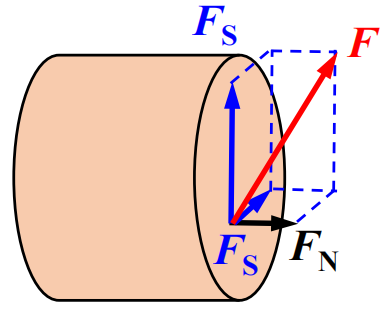
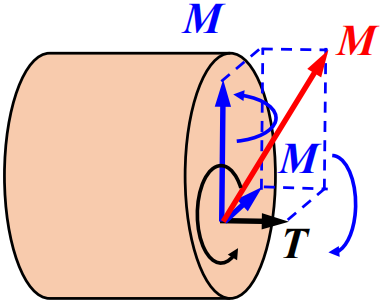
Internal forces is the force caused by the additional interactions inside the deformed member under loads. Internal forces include internal forces(specific) and moments.
2. Methods of Sections
To derive internal forces, we use method of sections. First, we need to cut. At the section of the internal forces, divided the member into two parts by the section
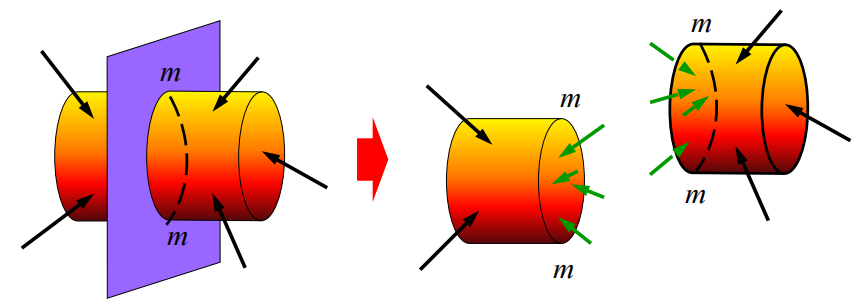
Then we take any part and discard the influence by the other part, and replace the influence using the corresponding internal forces acting on the section. Finally, establish the balance equations for the chosen part, and the unknown internal forces on the section are calculated by considering them as the external forces: